
How We Did It | The Guadalupe River Treetop Net
Some projects feel special from the very first conversation. This was one of them.
Perched high in a 250-year-old live oak named Parisa, this treetop net sits directly above the Guadalupe River in Seguin, Texas. The family had always dreamed of a treehouse—but the structure they imagined didn’t quite fit the branches they had. What they did want was a way to be immersed in the tree itself. No walls. No roof. Just a true connection to the canopy.
When they discovered treenets, everything clicked.

Why a Custom Net (and Not a Pre-Made One)
Like many families, they initially explored pre-made net options. But it didn’t take long to see the limitations—saggy panels, uncomfortable tension, and designs that simply don’t respond to the unique geometry of a living tree.
This is exactly why we build every treenet on site.
We came to Seguin and wove the net directly into Parisa’s branches, dialing in the tension by hand to create something that feels tight, bouncy, and deeply comfortable. To keep travel costs down, we brought our Sprinter van and set up camp along the river—living and working in the space for over a month. Evenings were spent fifteen feet up in the oak, listening to frogs and cicadas, talking long after the tools were put away.
We’re passionate about the work—but it’s the relationships that stay with us.

A Double-Decker Net World Between Two Oaks
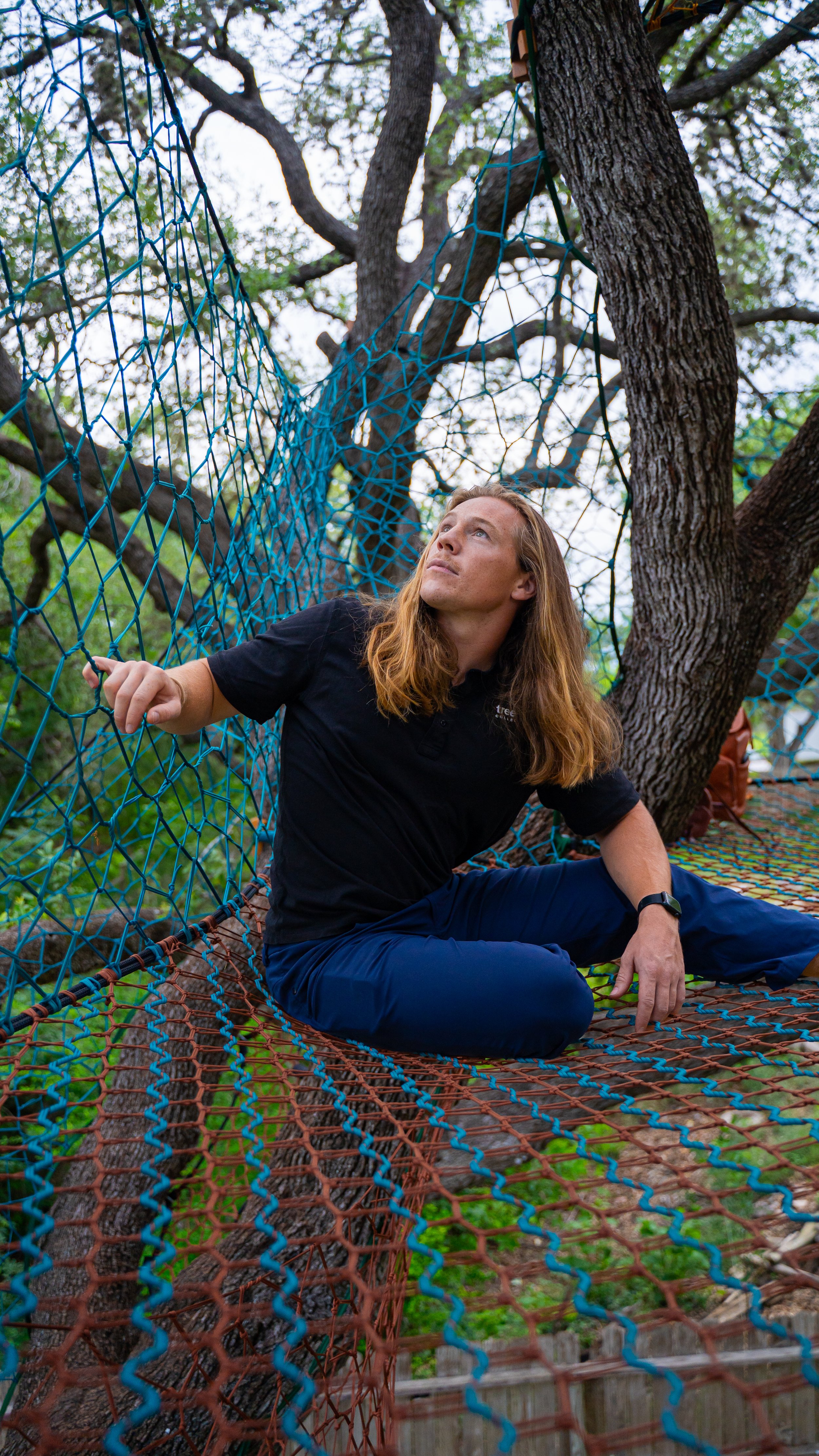
This project became a true double-deck treetop net world, woven between two massive oak trees. Parisa serves as the primary structure, with four main trunks growing in a mostly straight line. A neighboring oak—with long, sprawling limbs reaching across the property—offered incredible secondary anchor points and allowed us to push the design further than we could have with a single tree.
The result feels less like two separate trees and more like one continuous canopy.
How You Enter the Net
Access begins with rock climbing holds that lead you into what we call the “palm” of Parisa. From there, you’re immediately welcomed by chest-high net walls—something that wouldn’t have been possible without a large supporting limb from the neighboring oak.
A moki step ladder bridges the gap between branches, guiding you up into the first main platform. That platform is supported by a substantial limb from the second tree, creating the feeling of floating between trunks while still being held securely in place. It’s one of those spaces that makes you forget you’re standing in a structure at all.
Creative Rigging + Problem Solving
One of our favorite challenges on this build came where no vertical branches existed to anchor a tall, curved wall. The solution was what we call a “space leg”—a creative rigging technique where a long span of rope connects two sturdy anchor points, allowing us to create structure where nature doesn’t offer a straightforward solution. These are the moments we love most: when thoughtful rigging and responsive design unlock new possibilities.
The Cradle
Another standout feature of this net is an area we call the Cradle.
This section carries you from the first platform to the second, framing three large, spindly branches. It invites climbers—kids and adults alike—to move with the tree, climbing onto the branches themselves while still feeling fully supported by the net. You’re exposed, but never unsafe. Held, but never confined. It’s the kind of space that inspires both play and pause—where you can lie back, look through the leaves, and take in the river below.

Paracord Colors Used
For this build, color was about honoring the tree first.
Rust
Teal (a Treenet Collective crowd favorite)
Goldenrod
Moss Green
The lower level blends primarily Rust, creating a natural camouflage with subtle pops of Teal woven throughout. The upper level—affectionately referred to by the family as their “sunshine deck”—features Goldenrod paired with Moss Green. Together, the two levels feel like a floating sculpture that belongs exactly where it is.
What This Project Reminds Us Of
This treetop net isn’t just a structure—it’s a place where time slows down. Where kids climb higher than they thought they could. Where adults remember what it feels like to be held by a tree instead of standing beneath it. Projects like this are why we do what we do.They remind us that the most meaningful spaces aren’t built on the land—they’re built with it.